Carry out the given experiment:
Take four peeled potato halves and scoop each one out to make potato cups. One of these potato cups should be made from a boiled potato.
Place each of the potato cups in a beaker containing water as shown in the given figure.
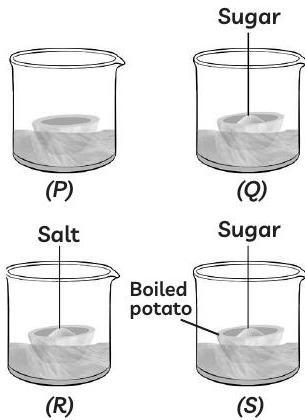
Now, set up the experiment as follows:
(I) Keep Cup (P) empty.
(II) Add one teaspoon sugar in Cup (Q).
(III) Add one teaspoon salt in Cup (R).
(IV) Add one teaspoon sugar in the boiled potato in Cup (S).
Observe the four potato cups for at least two hours and answer the following questions:
(A) Explain why water gathers in the hollowed portion of Cup (Q) and Cup (R).
(B) Why is Cup (P) necessary for this experiment?
(C) Explain why water does not gather in the hollowed portions of Cups (P) and (S).
(A) The sugar in cup (Q) and the salt in cup (R) make the solution inside the potato cups more concentrated than the water outside. The living potato cells act as a selectively permeable membrane, so water moves from the beaker (higher water concentration) into the cups (lower water concentration). As a result, water collects inside cups (Q) and (R).
(B) Cup (P) act as the control in the experiment. Since no solute is added to it, it shows that water does not move into the hollow portion unless a concentrated solution (either sugar or salt) is present. This helps confirm that osmosis is responsible for the movement of water in cups (Q) and (R).
(C) Water does not gather in:
(1) Cup (P) because there is no concentration difference between the inside of the cup and the surrounding water, so osmosis does not occur.
(2) Cup (S) because boiling destroys the selectively permeable nature of the potato cell membrane. Therefore, osmosis cannot take place even though sugar is present inside the cup.