
A researcher carried out an experiment in which she took two carrots of similar size. She placed one carrot in plain water and the other carrot in concentrated salt solution as shown in the given figure. After 24 hours she recorded her observations.
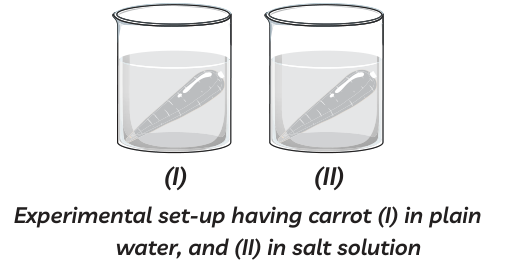
(A) What hypothesis does she want to test through this experiment?
(B) What would you suggest for the improvement of this experiment?
(C) Why does the carrot in plain water stay stiff and crunchy, but the carrot in concentrated salt solution become rubbery and limp?
(A) The researcher wants to test whether the concentration of the surrounding solution affects the movement of water through the cell membrane by osmosis. She hypothesises that a carrot placed in plain water will absorb water and become firm, while a carrot placed in concentrated salt solution will lose water and become soft and limp.
(B) The given suggestions could be made to improve the experiment:
(1) To improve the experiment, both carrots should be of the same size and shape, so that the comparison is fair.
(2) Their initial weights should be measured accurately before placing them in the solutions, allowing the change in weight to be calculated.
(3) A third carrot may be placed in an isotonic solution (having the same concentration as the carrot cells) to act as a control, where no significant change is expected.
(4) The volume of both solutions and the temperature should also be kept constant throughout the experiment.
(5) In addition, observations should be recorded at regular time intervals instead of only after 24 hours to better study the rate of osmosis.
(C) The cell membrane of carrot cells is selectively permeable and allows water to move through by osmosis.
When the carrot is placed in plain water, water enters the cells by osmosis, making the cells turgid and the carrot stiff and firm. When the carrot is placed in concentrated salt solution, water moves out of the cells by osmosis. The cells lose water and turgidity, causing the carrot to become soft, rubbery, and limp.